.png)
Your science is ready.
The mechanism is well-characterized, the preclinical data is compelling, and the clinical development path is coming into view. The next question — and one of the most consequential you will face — is who to bring alongside you to build the manufacturing and development infrastructure that gets your therapy to patients.
Selecting a contract development and manufacturing organization (CDMO) is both a scientific and strategic decision. Get it right, and you gain a true extension of your team: scientists and engineers who are just as invested in your program's success as you are. Get it wrong, and you may not find out until a GMP run goes sideways or an FDA inquiry lands that takes eight months to resolve.
Over the next four posts, we're going to give you the full framework for making this decision well.
What this series covers:
In Part 1 (you're here), we start with the landscape, what makes advanced therapy manufacturing categorically different from traditional biologics, and what the FDA data tells us about where manufacturing investment pays off. The numbers are clarifying.
In Part 2, we move to the first and most important evaluative criterion: modality-specific expertise. Not general manufacturing capability, direct, scientific experience with your biology. We'll show you how to assess it and what genuine depth looks like in a conversation.
In Part 3, we go deeper into process development philosophy, materials strategy, and facility readiness, the criteria that determine whether your first GMP run goes smoothly and whether your IND package holds up under review.
In Part 4, we close with the partnership model and the evaluation questions that surface what a capability presentation rarely does. These are the questions we'd ask. They work.
If you're actively evaluating CDMOs right now, you may want to read the whole series before your next meeting. If you're earlier in the process, start here and follow along — by the end, you'll have a framework you can actually use.
Let's start with the landscape.
The Advanced Therapy Manufacturing Landscape
Understanding the environment your program operates in — before you choose a partner
Your science is ready. The mechanism is well-characterized, the preclinical data is compelling, and the clinical development path is coming into view. The next question — and one of the most consequential you will face — is who to bring alongside you to build the manufacturing and development infrastructure that gets your therapy to patients.
Selecting a contract development and manufacturing organization (CDMO) is both a scientific and strategic decision. The right partner accelerates your timeline, strengthens your regulatory position, and brings the manufacturing expertise that transforms research-grade processes into reliable clinical execution. A strong fit means you gain a true extension of your team: scientists and engineers who are just as invested in your program's success as you are.
Before you can evaluate a CDMO effectively, it helps to understand the environment your program is operating in. Advanced therapy development is a uniquely complex manufacturing challenge, and the regulatory landscape reflects that complexity clearly.
Why Advanced Therapies Are Different
.jpg?width=768&height=512&name=pharma%20manufacturing%202%20(1).jpg) Advanced therapies — including cell therapies, gene therapies, viral vectors, and complex cell systems such as stem cell programs — present manufacturing challenges that are fundamentally distinct from traditional biologics. The biology is more sensitive, the processes are more operator-dependent, and the path from development to GMP execution requires a level of integration that many CDMOs are still building toward.
Advanced therapies — including cell therapies, gene therapies, viral vectors, and complex cell systems such as stem cell programs — present manufacturing challenges that are fundamentally distinct from traditional biologics. The biology is more sensitive, the processes are more operator-dependent, and the path from development to GMP execution requires a level of integration that many CDMOs are still building toward.
In a traditional small molecule or recombinant protein program, manufacturing is largely a chemistry or expression problem. You optimize conditions, validate the process, and scale. In advanced therapies, you are manufacturing living cells or biology-dependent vectors — systems that respond dynamically to process conditions, where small deviations can meaningfully affect product quality, potency, and safety.
This means the CDMO you choose is not simply executing a defined protocol. They are a scientific partner who must understand your biology deeply enough to develop processes that are robust, reproducible, and ready for regulatory scrutiny. The distinction matters enormously when it comes time to evaluate your options.
"The decisions made in process development directly shape the success of GMP manufacturing. The strongest programs build that foundation early, with the right team alongside them."
What the Regulatory Data Tells Us
The FDA data on advanced therapy development makes the stakes clear. Chemistry, manufacturing, and controls (CMC) strategy is consistently among the most consequential elements in regulatory review — and the programs that invest early in manufacturing infrastructure are the ones that move most efficiently through that process.
|
74% |
of FDA Complete Response Letters issued between 2020 and 2024 involved manufacturing or quality considerations, highlighting how central CMC strategy is to regulatory outcomes. |
|
~40% |
of IND submissions that are placed on clinical hold or require additional information cite CMC as a primary area for strengthening, underscoring the value of early and thorough process development. |
|
8.4 months |
is the average time required to resolve CMC-related inquiries from FDA — compared to 4.8 months for protocol-related questions — reflecting the technical depth these reviews require. |
These figures point clearly to where manufacturing investment pays off. Programs that engage deep manufacturing expertise early, build robust CMC packages, and select development partners with strong translational experience are the ones that move efficiently and confidently through this landscape.
For program leaders, this data reinforces a counterintuitive truth: the CDMO selection decision is not just a manufacturing decision. It is a regulatory strategy decision. The partner you choose will shape your CMC package, your IND readiness, and your ability to respond to FDA inquiries with data-supported confidence.
How to Think About This Decision
CDMO selection is often framed as a capability question: Does this organization have GMP suites? Do they have experience in my modality? Do they have capacity? These are valid questions, but they are not sufficient. The capability baseline is table stakes.
The more useful frame is alignment. Does this organization's scientific depth, development philosophy, team structure, and partnership model align with the complexity of your program? The strongest CDMO partnerships are built on genuine scientific engagement — not just manufacturing execution.
In the sections that follow, we walk through the specific criteria that separate a translational development partner from a contract manufacturer, the questions that surface scientific depth and organizational maturity, and the practical framework for making a decision you will have confidence in.
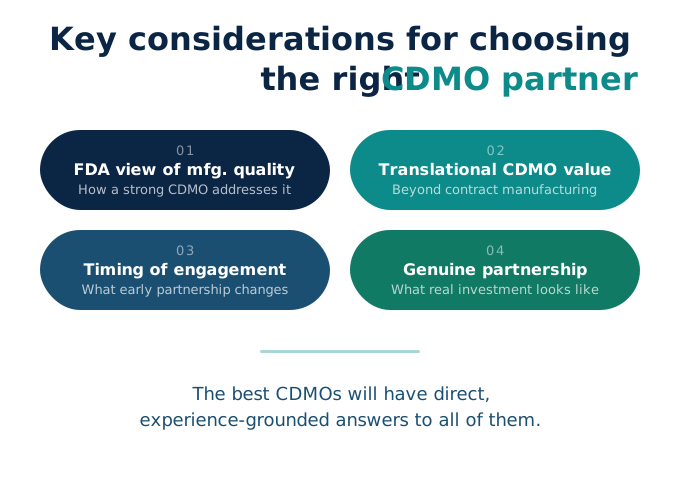
Key Questions to Bring into the CDMO Landscape
As you enter the evaluation process, a few foundational questions will help orient your thinking:
-
What is the FDA's current view of manufacturing quality in programs like mine, and how does a strong CDMO address that specifically?
-
What does a translational CDMO bring to a program that a standard contract manufacturer does not?
-
How early in my program does CDMO selection actually matter, and what does early engagement change?
-
What does a development partner who is genuinely invested in program success look like in practice?
COMING NEXT IN THIS SERIES
Part 2: Modality Expertise and Development Integration — Why direct experience with your specific biology is the primary filter in any CDMO evaluation, and what integrated development looks like in practice.
📩 Connect with us to learn how our capabilities can accelerate your program.