As Landmark Bio's analytical team has noted directly: achieving accurate size, concentration, and biomarker characterization of EVs is limited by today's analytical tools. That limitation does not make clinical development impossible - but it does make analytical strategy central to any credible EV program.
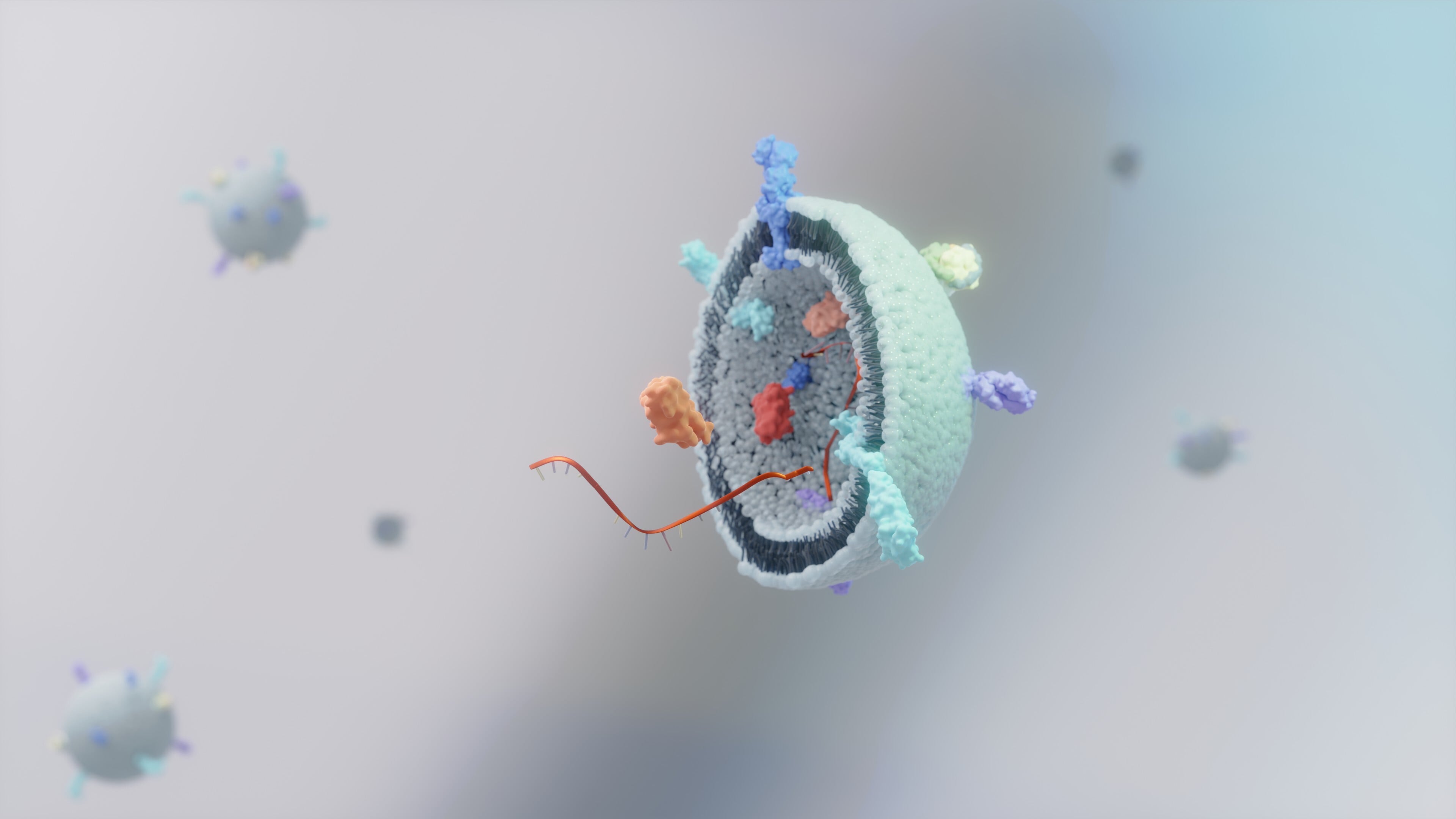
Extracellular vesicles have been a subject of scientific fascination for decades. For most of that time, they were studied primarily as mediators of intercellular communication - natural couriers shuttling proteins, nucleic acids, lipids, and metabolites between cells. What has shifted dramatically in recent years is the recognition that this biology can be harnessed therapeutically: EVs can be engineered, loaded, scaled, and delivered as a drug product.
That recognition has generated significant interest. It has also exposed a significant gap. The manufacturing and analytical infrastructure needed to move EV programs from research into the clinic is still catching up to the science.
Landmark Bio is working to close that gap.
What Are Extracellular Vesicles?
EVs are non-replicating, lipid bilayer-delimited particles naturally released by virtually all cell types. They are intrinsic to biological function - not an artifact, not a byproduct, but active mechanism cells use to communicate across distances and biological barriers.
Their structural properties make them attractive as therapeutic vehicles. Unlike synthetic nanoparticles, EVs are inherently biocompatible. Unlike viral vectors, they are non-replicating and carry a lower immunogenicity burden. They can be loaded with diverse molecular cargo - nucleic acids, proteins, small molecules - and surface-engineered to improve targeting.
The therapeutic applications being explored span oncology, neurology, regenerative medicine, and beyond. EVs are being studied as standalone therapeutics, as delivery vehicles for RNA and gene editing payloads, and as biomarkers for disease monitoring.
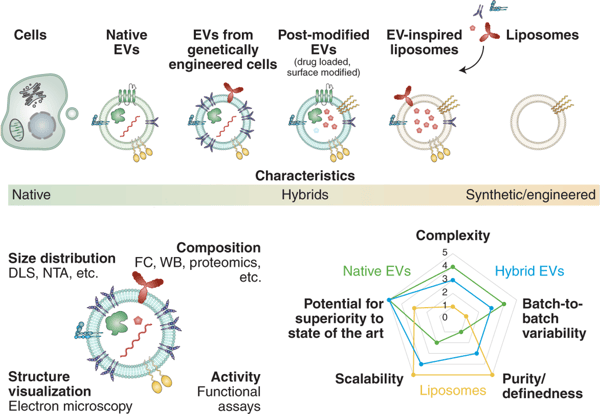 Figure 1. EVs can be grouped on the basis of their constituents, ranging from native EVs to highly engineered versions. Despite being highly functional and adaptable, their drawback has been largely around consistent and scalable manufacturing. (Image credit: Herrmann et al. 2021. Nature Nanotechnology)
The Manufacturing Challenge
Interest in EVs as a therapeutic platform has outpaced the infrastructure to support clinical development. Several challenges are well recognized across the field.
Cell source variability. EV production is inseparable from the biology of the producing cell. Different cell types - primary cells, stem cells, immortalized lines like HEK293T - produce EVs with distinct size distributions, surface marker profiles, and cargo compositions. Process decisions made early in development, including whether to work in adherent or suspension culture, at shake flask or bioreactor scale, have downstream consequences for product consistency and scalability.
Purification complexity. EVs exist in a complex biological matrix alongside cell debris, protein aggregates, and non-vesicular particles. Standard downstream approaches - harvest clarification, tangential flow filtration, column chromatography - each introduce variables that can affect yield, purity, and product integrity. Establishing a purification train that is both efficient and reproducible at scale is non-trivial.
Analytical limitations. This is the most acute bottleneck in EV development today. Achieving accurate, reproducible measurement of EV size, concentration, and surface marker identity using current analytical tools is genuinely difficult. No single method gives the complete picture. NTA and DLS provide size and concentration data but differ in sensitivity and resolution. Flow cytometry, if configured correctly, can add biomarker characterization. Getting these methods to agree - consistently across lots - requires deliberate method development and cross-validation.
Landmark Bio's Approach to EV Development
Landmark Bio's EV capabilities sit within a broader advanced therapies platform that spans cell therapies, viral vectors, nucleic acids, and non-viral delivery. That integration matters. EV programs often require expertise across multiple disciplines simultaneously - upstream cell biology, downstream bioprocessing, and analytical chemistry - and those disciplines need to be in conversation with each other throughout development.
Upstream Production
Landmark Bio works across a range of EV-producing cell types, including iMSC, MSC (iPSC-derived or primary), HSC, MKSC, and HEK293T cells. Both adherent and suspension production workflows are supported, with experience adapting adherent processes into scalable suspension systems - a transition that is technically meaningful and often necessary to achieve the production volumes required for clinical supply. Production is supported from shake flask to bioreactor scale.
Downstream Production
Landmark Bio's downstream EV workflow covers the full purification train: harvest clarification to collect EV-rich media, TFF concentration, column chromatography, sterile filtration, and formulation. The goal is a purification strategy that is not just effective at bench scale but translatable - one that holds up as production volumes increase and produces the batch-to-batch consistency regulators expect.
Analytical Development & Characterization
The core analytical challenge with EVs is that no single instrument reliably measures size, concentration, and identity simultaneously. The Landmark Bio analytical team developed a rapid method using conventional flow cytometry with Violet laser Side Scatter (VSSC) configuration to address this directly. Key findings from the work:
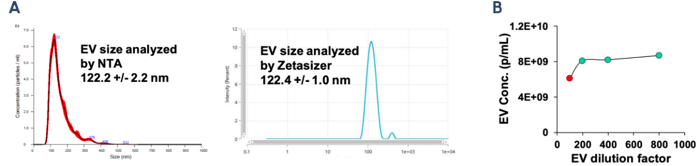 Figure 2. Consistent EV size & concentration across orthogonal methods. A) EV size measurements by NTA (122.2 +/- 2.2 nm) and Zetasizer (122.4 +/- 1.0 nm) were closely concordant, confirming measurement reliability across orthogonal instruments. B) EV concentration remained consistent across serial dilutions from 1:200 to 1:800, with a coefficient of variation of 3.77% - demonstrating excellent assay precision within the linear quantitation range.
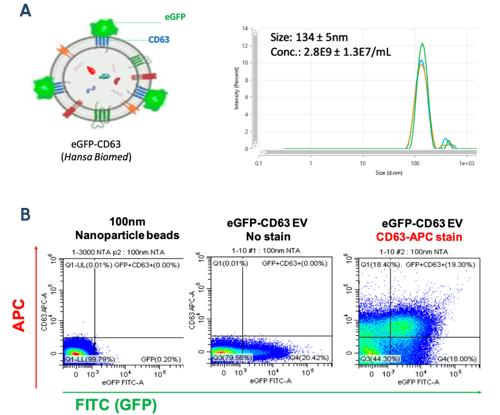 Figure 3. Verified EV identification through dual biomarker profiling. A) Verified EV identity through robust biomarker profiling (eGFP/CD63), enabling reliable release criteria and supporting regulatory expectations. B) High-precision analytical methods (<10% variance) provide dependable data for process development, scale-up decisions, and batch-to-batch comparability.
This method is applicable to real-time monitoring across EV process development - upstream scale-up, downstream purification, and lot release - and its performance attributes are relevant to quality-controlled release of EV products.
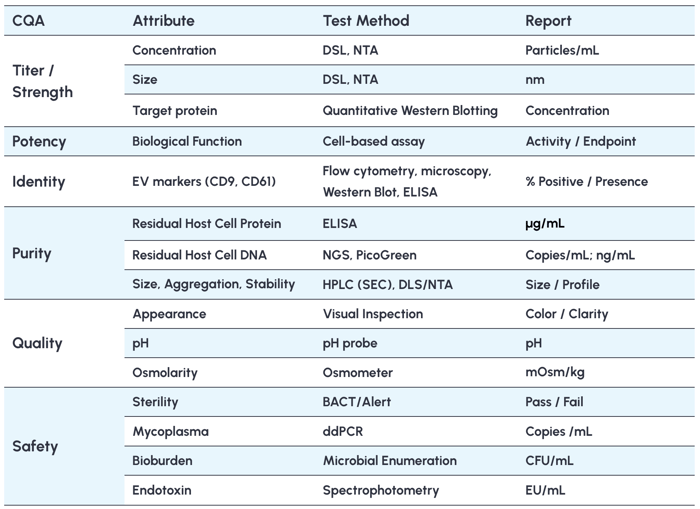 Table 1. The full analytical panel. Landmark Bio maintains a comprehensive EV analytics panel covering the critical quality attributes regulators expect for a therapeutic EV product.
Integration Across Development Lifecycle
One of the consistent lessons from the broader advanced therapy field is that programs suffer most at the transition points: from process development to GMP, from one analytical method to another, from one scale to the next. EVs are no different.
Landmark Bio's structure is designed to minimize those gaps. Process development, analytical development, quality control, and GMP manufacturing operate under one roof, with the same team maintaining continuity across stages. When an EV process moves from development to GMP-scale production, the team that developed it is the team executing it. The institutional knowledge does not have to be translated.
Looking Ahead
EVs represent one of the most scientifically compelling frontiers in advanced therapy development. The biology is real, the therapeutic rationale is strong, and clinical programs are beginning to accumulate. What has lagged is the manufacturing and analytical infrastructure to support serious clinical development at scale. This is the work Landmark Bio is doing.
Conclusion
Extracellular vesicles are moving from research curiosity to therapeutic reality. But realizing that potential requires solving hard problems in manufacturing and analytics - not just once, but reproducibly, at scale, under GMP conditions. Landmark Bio's integrated EV capabilities - spanning upstream production, downstream purification, and a comprehensive analytical panel anchored by validated flow cytometry methods - are designed to support programs from early development through clinical supply.
If you are building an EV program and thinking seriously about the manufacturing path forward, let's talk.
Authors: Eli Kraus, Yun Chen, Manish Tandon, and Gregg Nyberg contributed to the research and analytical development work described in this post.
📩 Connect with us to learn how our capabilities can accelerate your program.