In the previous post, we covered the two structural criteria that most reliably distinguish a translational development partner from a contract manufacturer: modality-specific expertise and integration across process development, analytical development, and GMP. These are necessary conditions for the kind of partnership that produces strong programs.
This post moves into the operational dimensions where development-forward thinking becomes visible at scale. The process development philosophy a CDMO brings to your program, the way it approaches materials qualification, and the maturity of its facility and quality systems are the factors that determine whether your first GMP run goes smoothly, whether your IND package holds up under FDA review, and whether the manufacturing partner you have chosen is genuinely ready for the complexity of your program.
These are not abstract criteria. They show up in concrete decisions made months before clinical manufacturing begins, and they compound through every subsequent stage.
1. Process Development Philosophy: Building for GMP from Day One
The approach a CDMO takes to process development tells you a great deal about how manufacturing will go. There is a significant difference between a CDMO that develops a process and then prepares it for GMP, and one that builds GMP readiness into every stage of development from the beginning.
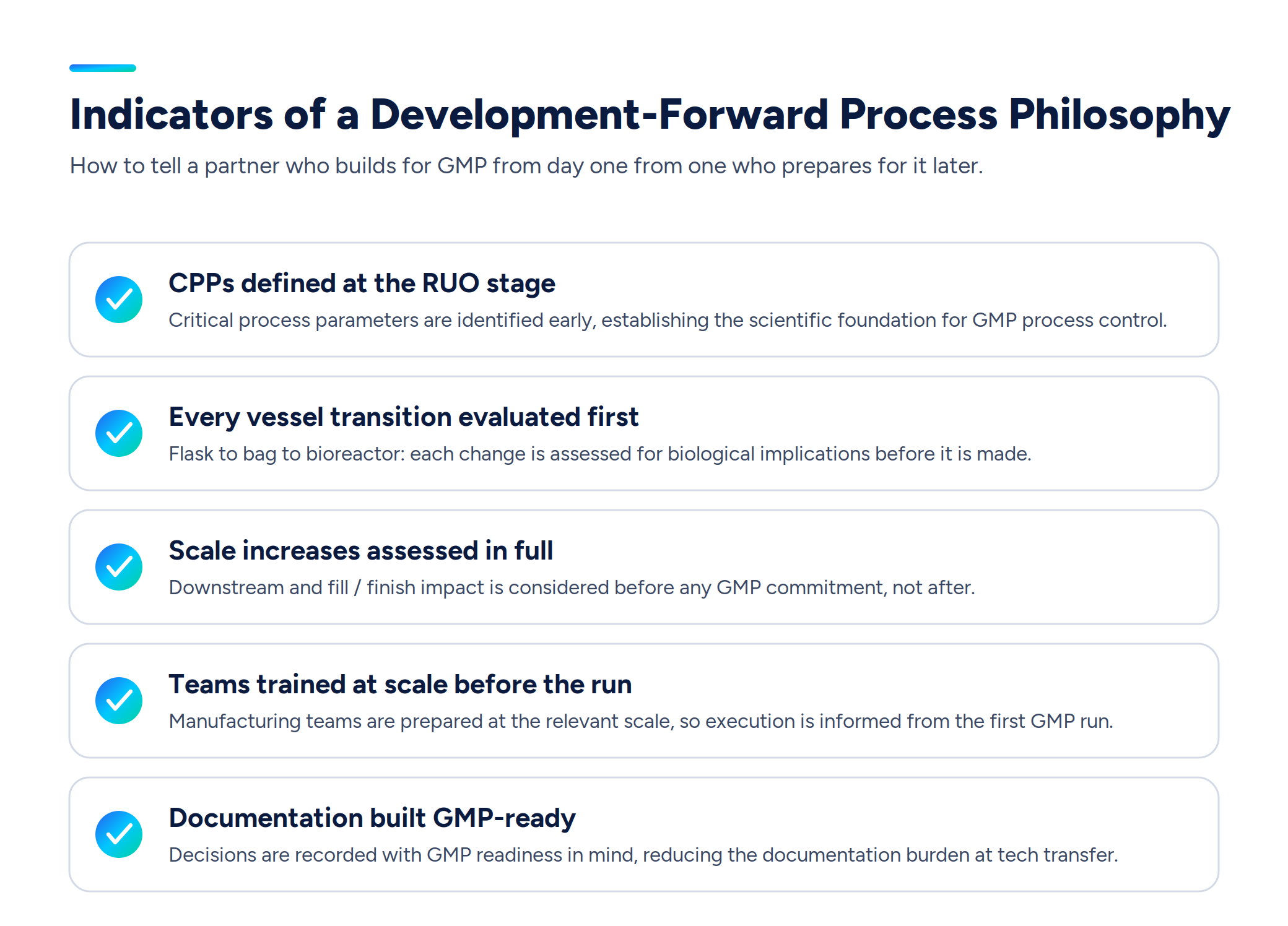
The strongest development partners operate from the second model. They evaluate process changes, vessel transitions, and scale increases with the full clinical manufacturing context in mind from the outset. They define critical process parameters during the research-use-only stage, so that the process understanding on which GMP execution depends is established before scale-up decisions are made. They treat every phase of development as preparation for the phase that follows.
This philosophy shows up in specific operational practices:
The practical difference this philosophy makes becomes visible at scale. Consider what scaling an iPSC program from four vessels to eight actually involves. It is not simply an increase in capacity. It represents a meaningfully different manufacturing day, with different processing timelines, expanded downstream operations, and greater demands on team coordination. A CDMO that approaches this with thorough pre-run analysis and structured operator preparation executes reliably. One that treats scale-up as primarily a logistical exercise works through those details as they arise, during GMP execution, under time pressure, with your program on the line.
"A development-forward process philosophy means every question about scale, materials, and process control is answered before GMP execution begins, not during it."
2. Questions That Surface Process Development Philosophy
These questions are particularly useful for assessing how a CDMO approaches the development-to-GMP transition:
- At what stage do you typically define critical process parameters, and what does that process look like in practice?
- Walk us through your approach to a vessel transition. What does the evaluation process look like before you move forward?
- How do you structure process development activities so that GMP teams have direct familiarity with the process before manufacturing begins?
- Can you describe a program where a process decision made in early development had a meaningful impact on GMP execution, either positively or as a lesson learned?
A CDMO with a genuinely development-forward philosophy will engage with these questions with the specificity that comes from having consistently built processes this way.
3. Materials Strategy: Designing for Clinical Manufacturing from the Start
Materials qualification is one of the most impactful and most frequently underestimated decisions in early process development. Research-grade materials that work well in the laboratory often require replacement or requalification before clinical manufacturing, because the sourcing, testing, and documentation requirements for GMP-grade materials are fundamentally different.
When this transition is left to the technology transfer stage, it creates real problems. Swapping a critical raw material at that point can require partial or full process re-characterization, disrupt timelines, and generate regulatory complexity. Addressing it during process development, with full process context available, means the bill of materials is GMP-ready from the first clinical run.
A CDMO with strong translational expertise will approach materials strategy proactively and comprehensively:
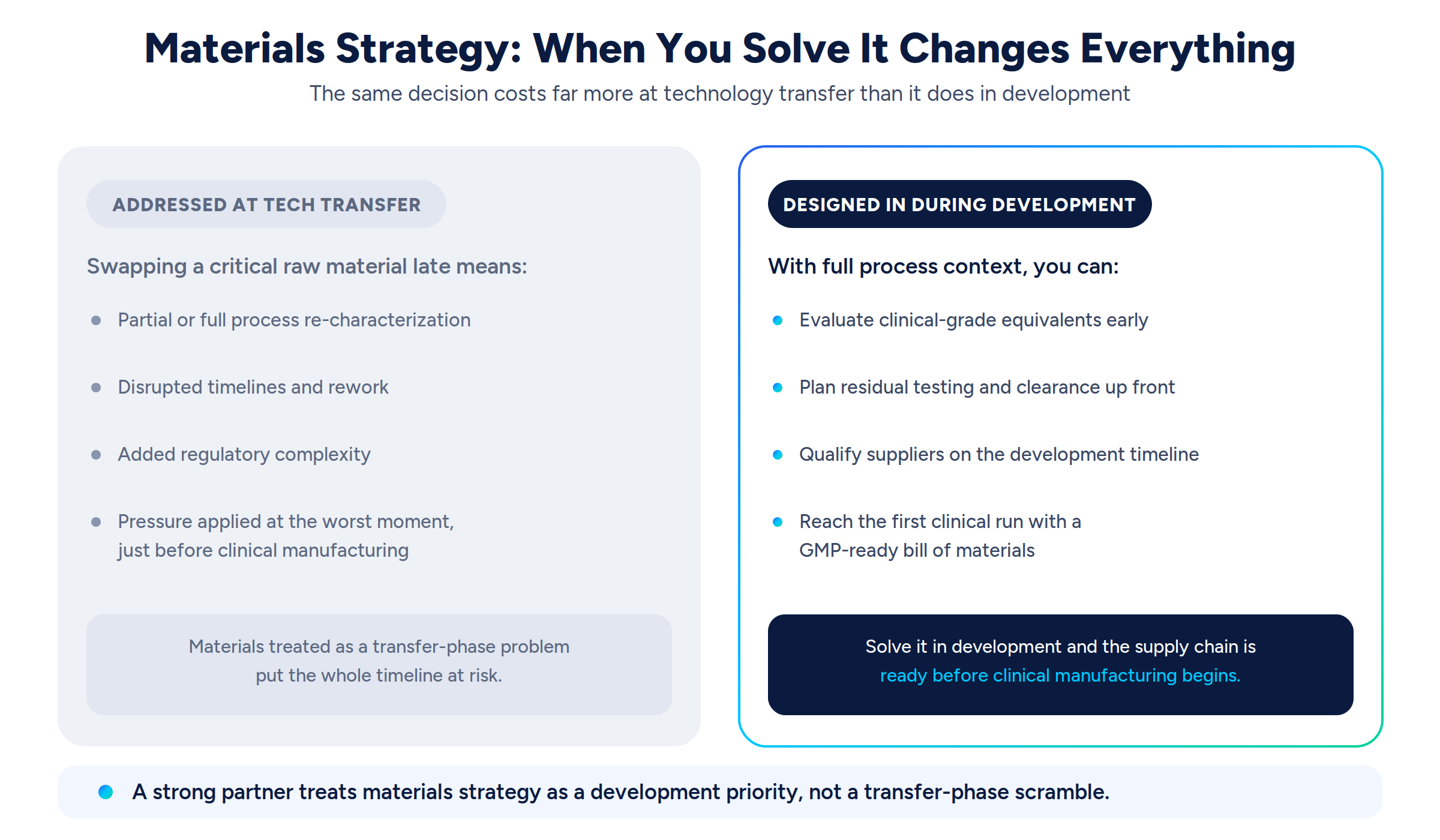
Materials strategy is an area where engaging a CDMO early in development pays particularly high dividends. The decisions made about sourcing, qualification, and documentation in the research phase establish the supply chain and regulatory foundation for clinical manufacturing. A CDMO that treats materials strategy as a development-phase priority, rather than a transfer-phase problem, gives your program a meaningful structural advantage.
4. Facility Infrastructure and Quality Systems
A CDMO's physical infrastructure and quality management systems are the foundation on which everything else rests. Before selecting a partner, it is worth understanding both in detail and going beyond the capability deck to ask the specific questions that reveal operational maturity.
Facility Considerations
Suite classification and availability: What is the ISO classification of the GMP suites, and how many independent suites are available for your program? Programs that require long development timelines or multiple manufacturing runs benefit from dedicated suite access; shared suite environments introduce scheduling complexity that can affect timelines.
Modality support: Does the facility genuinely support your specific program type, including the specific culture formats, process equipment, and fill/finish capabilities your biology requires? Modality support at the marketing level and modality support at the operational level are not always the same thing.
Capacity and scheduling: What is the current capacity outlook, and what is the typical program scheduling lead time? A CDMO with strong demand may have significant lead times for GMP suite access, which will affect your program planning.
Quality and Regulatory Considerations
Audit track record: Has the facility been audited by sponsors for GMP manufacturing and release testing? What has the experience of those audits been? A track record of successful sponsor audits is evidence of operational maturity, not just documented processes, but processes that hold up under external scrutiny.
FDA engagement: Has the CDMO engaged directly with the FDA through a Pre-IND, Type B, or Design Review Meeting for programs in your modality? What came from those engagements, and how has that feedback shaped the CDMO's approach? Direct FDA engagement is a meaningful indicator of regulatory depth and the ability to anticipate review requirements.
QMS maturity: Is the quality management system mature and operating at scale, or still in active development? For programs targeting IND filing within 12 to 18 months, a CDMO whose QMS is still being built out represents a material risk.
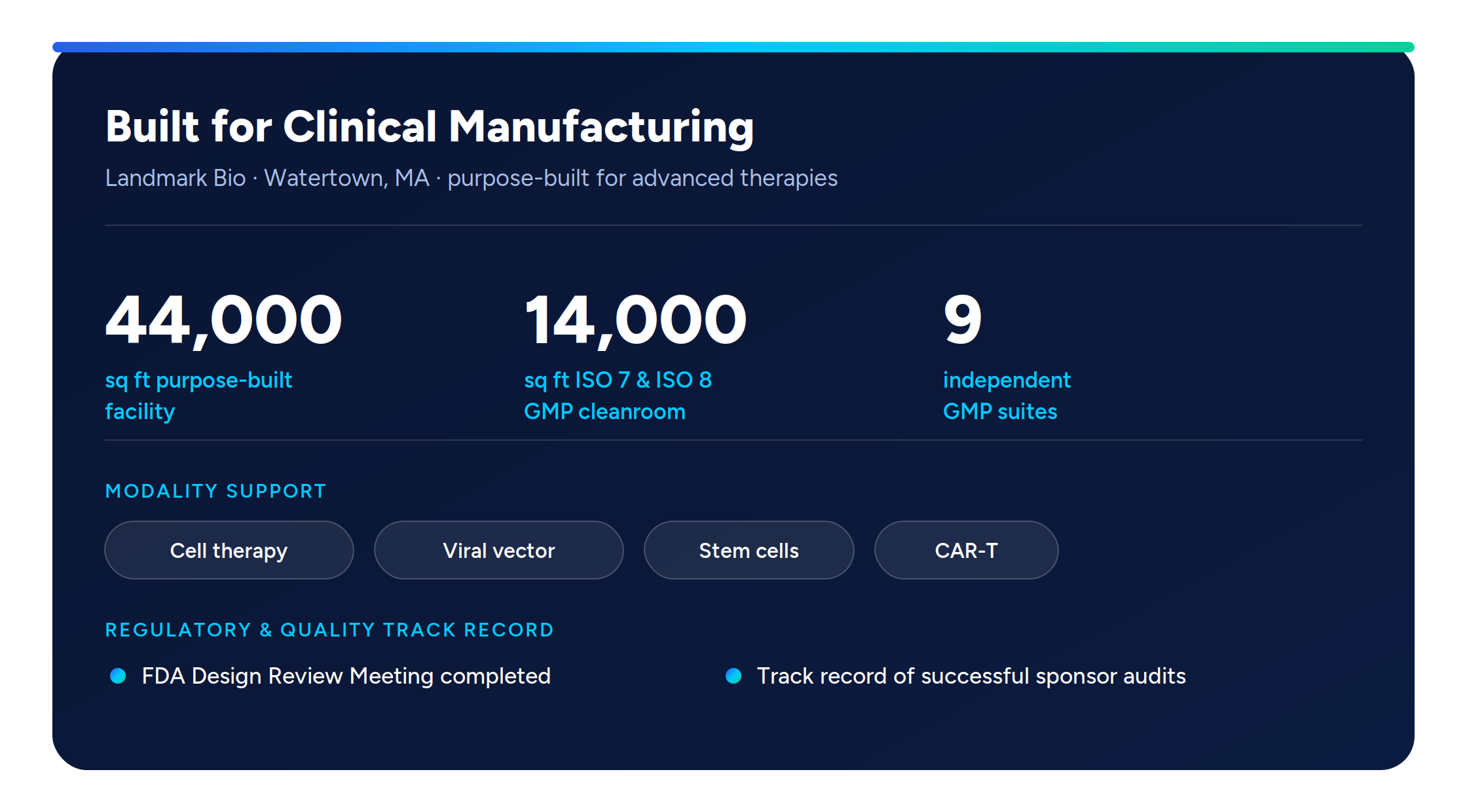
Landmark Bio operates a 44,000 sq ft purpose-built facility in Watertown, MA, with 14,000 sq ft of ISO 7 and ISO 8 GMP cleanroom space across 9 suites. The facility supports cell therapy, viral vector, and complex cell system programs, including stem cells and CAR-T. Landmark has completed an FDA Design Review Meeting and has a track record of successful sponsor audits for GMP manufacturing and release testing.
Looking Ahead
Process philosophy, materials strategy, and facility readiness are the operational dimensions of a CDMO partnership. Together with modality expertise and development integration, they describe what a CDMO can do. What they do not describe is how it will feel to work together day to day, and how the partnership will hold up when challenges arise.
In the final post in this series, we turn to the dimensions that are most difficult to assess from a capability document and most important to get right: the partnership model itself, and the evaluation questions that surface what formal presentations rarely do.
COMING NEXT IN THIS SERIES
Part 4: Partnership Model and the Questions That Reveal the Most
What a high-quality CDMO partnership looks like in practice, and the evaluation questions that surface what a capability presentation cannot.